Maintenance · 11 min read
Why mechanical seals fail — and how to make them last.
Seal failures are rarely about the seal. They're about how the pump runs around it. Here's what we see, what causes it, and what to change.
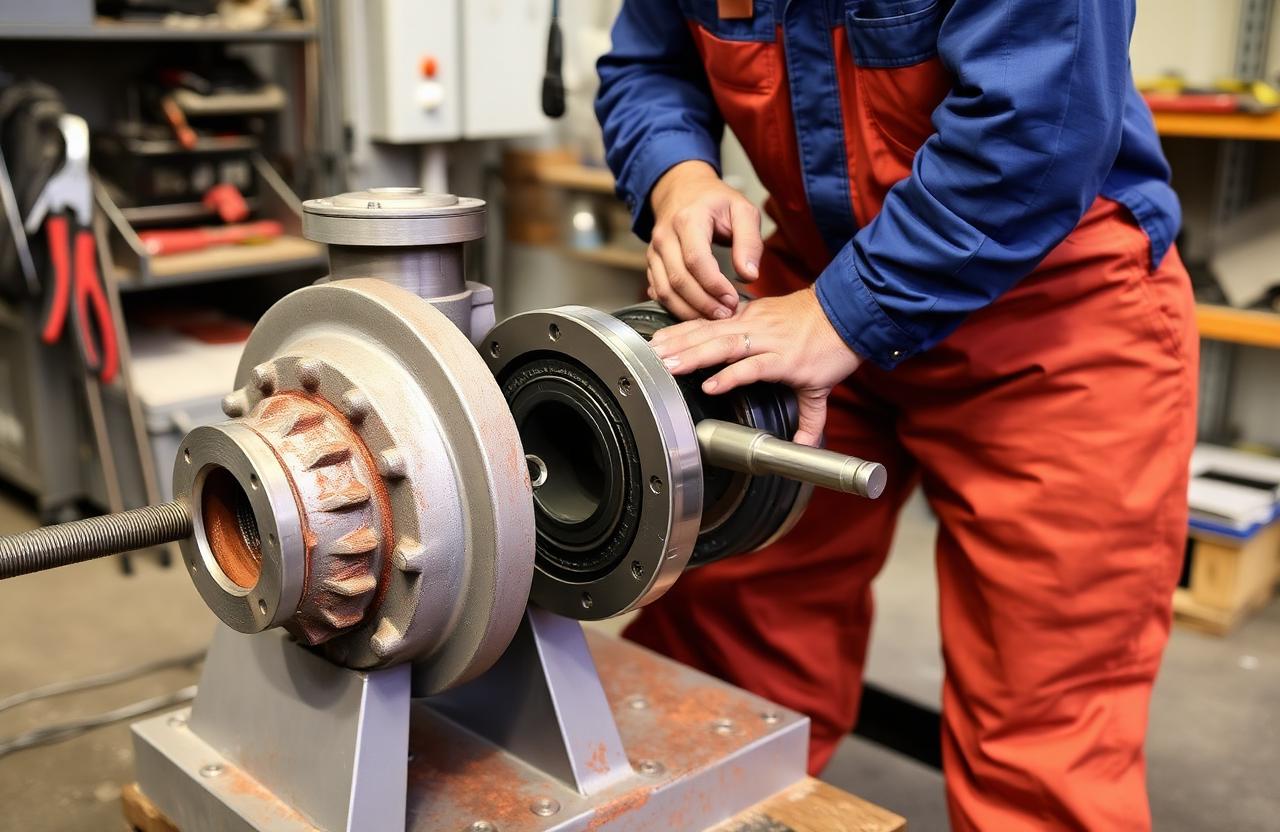
Mechanical seals are the most replaced component on most centrifugal pumps, and they're also the most misunderstood. The standard reaction to a leaking seal is to swap it for another seal of the same type, reinstall, and hope for the best. About a third of the time that works. About two-thirds of the time the new seal fails the same way the old one did, usually in less than half the expected life, because nothing about the underlying cause changed.
Seal failures are almost never about the seal itself. They're about what's happening in the seal chamber: pressure, temperature, contamination, vibration, and lubrication conditions that the seal was either never designed for or no longer sees because the pump has drifted from its original operating point. This article is the failure-mode field guide we hand to operators and shop techs to help them distinguish a 'replace the seal' problem from a 'fix the pump' problem.
Dry running: the single most common killer.
Mechanical seals depend on a thin film of fluid between the rotating and stationary faces. That film carries the load, dissipates heat, and prevents the faces from welding themselves together. Lose the film and you have a few seconds before the faces overheat, the elastomers melt, and the seal turns to powder.
Dry running causes are usually upstream of the pump. Empty suction reservoirs, gas binding in vertical pumps, runaway draw-down on wet-well lift stations, and operator error during startup all expose the seal to dry conditions long enough to destroy it. The failure mode is distinctive: heat-checked faces, burned elastomers, sometimes blue oxidation on the carbon stationary face.
Prevention is mostly procedural and instrumented. Add low-suction-pressure cutouts that actually work. Train operators to vent pumps before startup on suspect installations. On systems that frequently run dry by design (sump pumps, intermittent transfer pumps), specify seal designs intended for that service — cartridge seals with face geometries tolerant of brief dry events, or air-actuated seal-saver flush systems that pulse a fluid film during dry periods.
Misalignment and bent shafts.
Modern mechanical seals tolerate very little shaft runout. Most manufacturer specs call for less than 0.002 inches of total indicated runout at the seal chamber face, and total system runout from coupling-to-pump-impeller measured in single-digit thousandths. Beyond those limits, the seal faces work loose, the elastomers fatigue, and the seal fails in weeks rather than years.
Alignment failures show up after coupling rebuilds, baseplate movement, foundation settlement, or thermal growth that wasn't accounted for at installation. The seal symptoms are characteristic: leak path concentrated on one side of the seal chamber, uneven face wear, accelerated O-ring degradation, and a service life dramatically shorter than catalog claims.
Prevention is laser alignment at installation, periodic re-checks (annually for high-duty pumps, semi-annually for problem installations), and proper hot alignment procedures on pumps that see significant thermal cycling. A 30-minute alignment check at every seal change saves an enormous amount of repeat work.
Abrasives and contamination.
Water that looks clean often isn't. Sand from new well completions, scale from aging cast-iron mains, biofilm sloughed from storage tanks, and grit from inadequate strainers all wind up in the seal chamber, where they grind the faces apart from the inside out.
The classic abrasive-failure signature: grooved seal faces, worn shaft sleeves, gritty residue in the elastomers, and a leak that starts subtle and accelerates fast. Seal life on contaminated service is often a fraction of catalog life — what should be a five-year seal lasts six months.
The fix is API piping plans, specifically Plan 32 (external clean flush) or Plan 23 (recirculation through a cooler and strainer) for severely abrasive service. Both keep clean fluid at the seal faces regardless of what's in the pumped product. On lighter contamination, Plan 11 (recirculation from pump discharge through an orifice and back to the seal chamber) sweeps abrasives away from the faces and is the default for most clean-water pumps anyway.
Thermal shock and heat buildup.
Seal faces hate sudden temperature change. A cold pump that gets a slug of hot fluid through it (steam-injected CIP cycles, hot-water transfer pumps, plant restart events) sees seal-face thermal gradients that crack stationary carbon faces and check rotating silicon-carbide faces.
Steady-state high temperature causes its own problems. Elastomers age out fast above their rated temperature. Lubrication films thin and break down. The seal manufacturer's catalog life assumed an operating temperature; running 30 degrees above that often halves the realistic service life.
Mitigation: pre-warm pumps that will see hot service. Add seal-chamber cooling jackets on hot-water duty. Specify elastomers and face materials to the actual operating temperature, not the nominal rating. On thermal-cycling service, choose seal designs with floating stationary elements that can absorb gradient stress without cracking.
Vibration and operation away from BEP.
Pumps operated far from best-efficiency-point experience hydraulic forces the bearings and seals weren't designed to absorb. Running at low flow causes internal recirculation that drives radial loads into the bearings and translates into seal-chamber vibration. Running at very high flow drives the suction toward cavitation, which hammers the seal with pressure pulses.
Seals on pumps operated at 50% or 130% of BEP almost always live shorter lives than the same seals on pumps operated near BEP. The fix is rarely 'better seals.' It's a hydraulic review and either an impeller trim, a system re-balance, or a duty-point change that puts the pump back inside its competent range.
When you see a pump that keeps eating seals despite every other intervention, pull the curve and the duty data. The answer is usually that the pump is operating somewhere it never should have been specified for.
Choosing the right seal for the service.
There is no universal seal. The right seal depends on the fluid, the temperature, the pressure, the abrasive content, the duty cycle, and the consequences of failure. The default 'unbalanced single-spring component seal' that ships standard on commodity pumps is fine for clean cold water at modest pressures and nothing else.
For most municipal water and wastewater service, the right starting point is a balanced cartridge seal with silicon-carbide-on-silicon-carbide hard faces and FKM (Viton) elastomers, sized for the actual operating pressure with the appropriate API piping plan. The slightly higher cost over a component seal is recovered the first time you avoid a repeat failure.
For aggressive service — high pressure, high temperature, abrasive, or process chemistry — consult a seal vendor who is willing to look at your actual operating data and not just sell you their highest-margin product. The good ones are happy to do that. The bad ones aren't worth working with.
What to capture every time a seal fails.
Every seal failure is a free data point about the pump it came from, if you bother to capture it. At minimum, photograph the failed seal before disassembly. Note where the leak path was concentrated. Document the wear pattern on both faces. Inspect the elastomers for thermal damage, swell, or extrusion. Check the shaft sleeve for grooving or pitting. Pull a vibration spectrum on the pump if you have the gear.
Patterns emerge fast. A station where every failure shows abrasive grooving is telling you the strainer is undersized or the source has changed. A pump where every failure shows thermal damage is running hotter than spec. A unit where seals keep failing on the same side of the chamber has a misalignment problem.
Three or four data points usually point to the underlying cause. Address that cause and the seal-change interval often doubles or triples without any change in seal selection. The seal vendors love that as much as you do — repeat failures are bad for everyone except the parts counter.